 |
Arts of the Islamic World
Sale: L08220 | Location: London, New Bond Street
Auction Dates: Session 2: Wed, 09 Apr 08 2:30 PM
LOT 375
PROPERTY OF A SWISS COLLECTOR
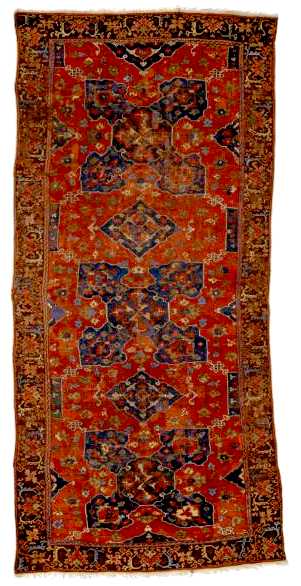
A 'STAR' OUSHAK CARPET, WEST ANATOLIA,
12,000—18,000 GBP
MEASUREMENTS
approximately 415 by 202cm., 13ft. 8in. by 6ft. 8in.
DESCRIPTION
late 16th century
end borders rewoven, outer edges of side borders rewoven, scattered
reweaves
CATALOGUE NOTE
Written records indicate that carpets and rugs were woven in the city
of Oushak in Western Anatolia as early as the late fifteenth century.
Weavers in Oushak were the first in the Ottoman Empire to produce
carpets for the European market where, during the Renaissance and the
Baroque periods, carpets were held in especially high regard. Rugs and
carpets from Oushak were imported to adorn the residences of the
political and financial elite and to serve as a veritable symbol of
wealth and status. These weavings also appeared in the works of the
most distinguished artists of the time, such as Jan Vermeer or Paris
Bordone, for example in the latter's 'The Delivery of the Ring to the
Doge' of circa 1535, now in the Gellerie dell'Accademia, Venice,
inv.no.318. Carpets and rugs from Oushak were produced with many
different patterns arranged in accordance with the principle of the
endless repeat, but few were as complex in their arrangement of motifs
as Medallion and Star Oushak carpets. The lot offered here, with its
large quatrefoil lobed stars, is an outstanding example of a Star
Oushak carpet from the late sixteenth century. As surviving pieces and
written accounts suggest, Star Oushak carpets were not produced after
the seventeenth century and were perfected in a very short period of
time. Interestingly, these carpets never showed any signs of demise
before their sudden disappearance in the late 1600s. Star Oushak
carpets can be embellished with different variants of the star motif
and it has been suggested that pieces with four-lobed stars predate
those with eight-lobed stars, see Donald King, "Turkish Carpets in the
Victoria and Albert Museum," Hali, Vol.6 No.4, 1984, p.367. It has also
been suggested that the designs of the tiles of the sixteenth-century
Gök Mescid mosque in Tabriz could have been a source for the
development of the Star Oushak pattern, see Oktay Aslanapa, One
Thousand Years of Turkish Carpets, Istanbul, 1988, p.113. What makes
the current lot particularly interesting and rare is the unusual
combination of three different design elements that make this piece
more complex than the majority of Star Oushak carpets and rugs. These
elements are the quatrefoil star, the diamond-shaped medallion and the
square medallion. Among the very few examples with a similarly
intricate design is a quatrefoil Oushak rug in the Joseph Lees Williams
Memorial Collection in the Philadelphia Museum of Art that has a
virtually identical arrangement of motifs, see Charles Grant Ellis,
Oriental Carpets in the Philadelphia Museum of Arts, Philadelphia,
1988, p.70. Another carpet with a comparable design can be found in the
Metropolitan Museum of Art in New York, see Walter B. Denny, Anatolian
Carpets, Washington, D.C., 2003, p.42. An unusual feature is the use of
the palmette and leaf border design, on a dark brown ground, in
combination with Star field design. The overall rarity of this piece,
together with the unusual combination of design elements and its rich
and vibrant colour, makes the current lot a rare opportunity for
today's collectors. |
Thanks and best wishes,
J. Barry O'Connell Jr.
|
Persian
Rugs the O'Connell Guides
Tabriz
Rugs
Kashmar
Rugs
Isfahan
Rugs
Hamadan
Rugs
Mashad
Rugs
Gabbeh
Rugs
Heriz
Rugs
Ardabil
Rugs
Lylyan
Rugs
Turkmen
Rugs
Persian Rugs
Turkish Rugs
Suzani
Oriental
Rugs
Persian
Carpets
Baluch Rugs,
The Qashqai and
Qashqai Rugs
Veramin Rugs
Tribal Rugs
Khotan-Rugs
Khotan-Carpets
Kirman-Rugs
Kirman-Carpets
Antique-Rugs
Antique-Carpets
Shahsevan-Rugs
Oushak-Rugs
Mashad-Rugs
Gabbeh-Rugs
Kurdish-Rugs
Becoming
Missional
|